Elephants are among the most intelligent and social animals in the world. They have strong family bonds, use different sounds to communicate and show many types of emotions. Their behaviour can tell us a lot about what they feel and how they interact with other elephants.
But have you ever wondered how elephants communicate with humans? Why do they touch each other with their trunks? How can you understand their body language? And what should you know before visiting an elephant?
Understanding elephant interaction helps us respect these wonderful animals. It also makes an elephant experience more meaningful and safe.
In this guide, we will explore 10 important things about elephant interaction, including their behaviour, communication, social life, body language and welfare.
What Is Elephant Interaction?
Elephant interaction means the way elephants communicate and behave with other elephants, animals and their surroundings. It includes physical contact, sounds, movements, social activities and responses to different situations.
Elephants use their trunks, ears, tails and voices to share information. They also build strong relationships with their family members.
Human interaction is different. When people observe elephants, they should give them enough space and allow them to behave naturally. Touching or feeding an elephant should only happen when it is part of a properly managed, welfare-led activity.
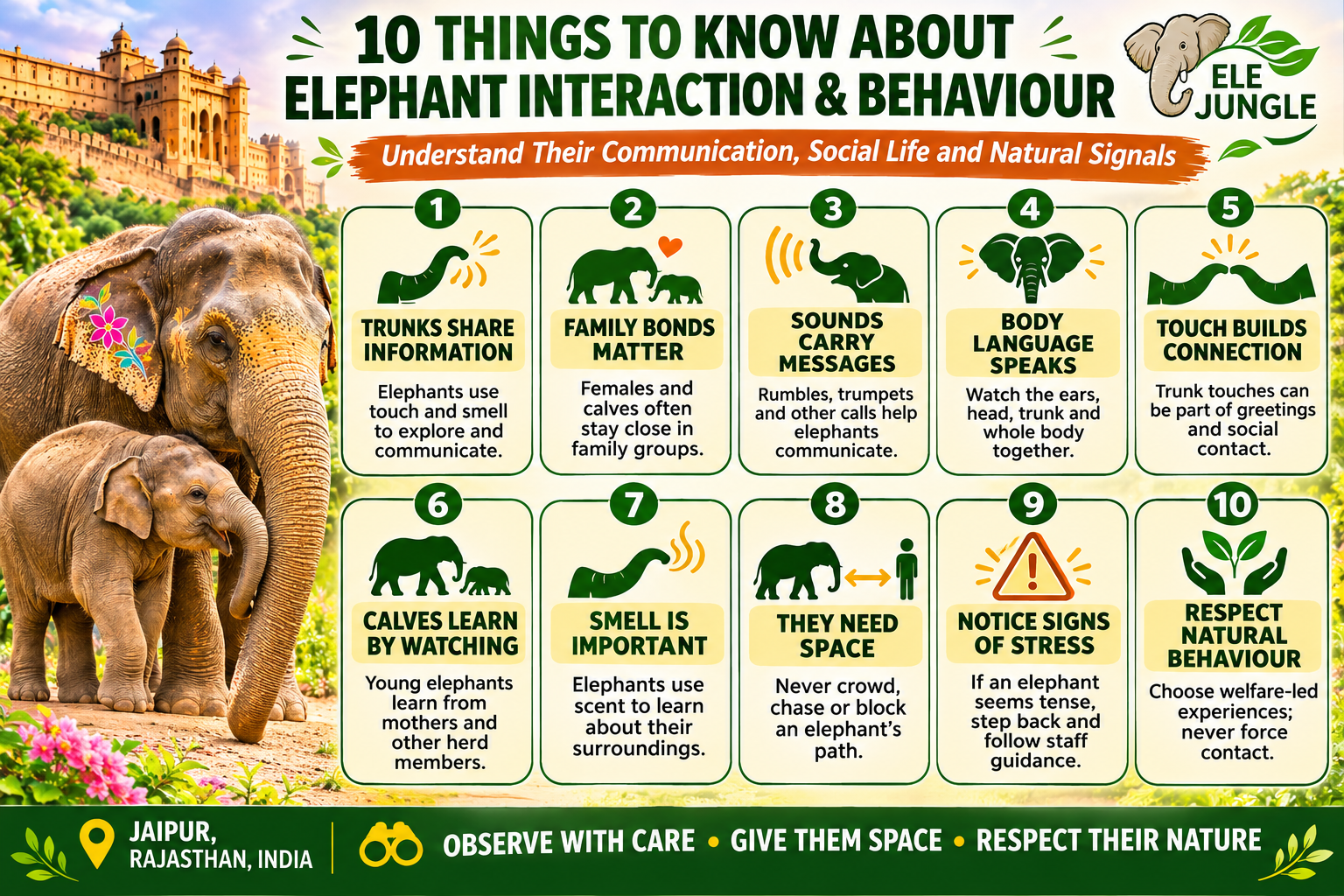
Here are 10 important things you should know about elephant interaction.
1. Elephants Use Their Trunks to Communicate
An elephant's trunk is one of its most useful body parts. It works like a nose, hand and drinking tool. An elephant uses its trunk to smell, pick up food, drink water and communicate with other elephants.
You may see two elephants touching each other's faces or trunks. This is one way they explore and communicate with each other.
Elephant calves also use their trunks to explore the world. They often touch their mothers and other family members while learning about their surroundings.
How Do Elephants Use Their Trunks?
| Trunk activity | What it means |
|---|---|
| Touching another elephant | Social contact and exploration |
| Picking up food | Feeding |
| Smelling the ground | Finding food and learning about the area |
| Spraying water | Bathing and cooling the body |
| Raising the trunk | Can help with smelling and sensing the surroundings |
| Touching a calf | Care and social bonding |
An elephant's trunk contains around 150,000 muscle units. This makes it very flexible and useful for many daily activities.
When you watch elephants at Ele Jungle, notice how they move their trunks while eating, exploring and interacting with their surroundings.
2. Elephants Have Strong Family Bonds
Elephants are social animals. They often live in family groups made up of females and their young ones.
An older female, called the matriarch, usually leads the family. She helps the group find food and water. She also helps protect younger elephants from danger.
Young elephants learn many things by watching their mothers and other family members.
For example, calves learn how to find food, use their trunks and recognise sounds from other elephants.
How Do Elephant Families Stay Connected?
| Family member | Main role |
|---|---|
| Matriarch | Guides and protects the family |
| Mother elephant | Feeds and cares for her calf |
| Young calf | Learns through watching and exploring |
| Other adult females | Help protect and care for young elephants |
| Young elephants | Play and learn social behaviour |
Family relationships are very important for elephants. They can stay connected with their family members for many years.
This is one reason why elephant welfare and social contact are so important.
3. Elephants Communicate Through Different Sounds
Elephants do not communicate only through physical contact. They also use different sounds to share information.
Some sounds are easy for humans to hear, while others are too low for our ears.
You may hear an elephant making a loud trumpet sound. This can happen when it feels excited, surprised or disturbed.
Elephants also make low rumbling sounds. These sounds help family members communicate with each other.
Common Elephant Sounds and Their Meanings
| Elephant sound | Possible meaning |
|---|---|
| Trumpeting | Excitement, alarm or distress |
| Low rumbling | Communication with other elephants |
| Roaring | Strong emotional response or alarm |
| Grunting | Social communication |
| Soft rumbling | Contact and bonding |
Elephants can also use low-frequency sounds that travel long distances. Some of these sounds create vibrations in the ground.
Other elephants may detect these vibrations through their feet and body.
This helps them stay connected even when they cannot see each other.
4. Elephant Body Language Tells Us How They Feel
Elephants use their bodies to communicate. Their ears, eyes, tails, trunks and head movements can give us useful information about their behaviour.
Learning about elephant body language helps people understand when an elephant is relaxed, alert or uncomfortable.
However, one movement does not always tell the full story. You should look at several signs together and keep a safe distance.
Important Elephant Body Language Signs
| Body part | Behaviour | What it may indicate |
|---|---|---|
| Ears | Slow flapping | Cooling the body |
| Tail | Natural movement | Normal activity |
| Tail | Stiff or held out | Possible alertness or stress |
| Eyes | Wide and alert | Increased attention or concern |
| Trunk | Raised | Smelling or checking surroundings |
| Head | Repeated shaking | Possible warning or discomfort |
For example, elephants flap their ears to help cool their bodies. This is a normal behaviour, especially in warm weather.
However, an elephant facing you with its ears spread, head raised and body tense may be showing a warning.
Never try to approach an elephant to test its behaviour. Give it space and follow the instructions of trained animal-care staff.
5. Elephants Show Love and Care Through Physical Contact
Elephants have strong social relationships. They often use physical contact to communicate with their family members.
You may see elephants touching each other with their trunks, standing close together or resting their trunks on another elephant.
Mother elephants also use physical contact to guide and protect their calves.
Young elephants often stay close to their mothers because they depend on them for food, safety and learning.
Common Types of Elephant Physical Contact
| Physical activity | Why elephants may do it |
|---|---|
| Trunk touching | Social communication |
| Standing close | Comfort and social bonding |
| Trunk around another elephant | Contact and bonding |
| Gentle pushing | Play or social behaviour |
| Mother touching calf | Care and guidance |
These behaviours show how important social relationships are in elephant life.
Elephants are not simply large animals living together. They have complex relationships that develop over time.
6. Elephant Feeding Is an Important Part of Their Daily Life
Elephants spend a large part of their day eating. Their large bodies need a lot of food and water to stay healthy.
They eat different types of plants depending on their habitat and the season.
Their natural diet includes grass, leaves, fruits, roots, bark and branches.
The trunk helps them collect food and bring it to their mouths.
What Do Elephants Eat?
| Food | How elephants use it |
|---|---|
| Grass | An important part of their diet |
| Leaves | Provide plant nutrients |
| Fruits | Provide natural energy |
| Tree bark | Provides fibre |
| Roots | Another natural food source |
| Branches | Used as food in some habitats |
An elephant may spend up to three-quarters of its day eating.
Watching an elephant feed can help visitors understand how its trunk works.
However, visitors should never bring their own food or feed an elephant without permission from trained animal-care staff.
Food must be suitable for the animal and given in a safe and controlled way.
7. Mother Elephants Protect Their Babies
The relationship between a mother elephant and her baby is one of the most interesting parts of elephant social life.
A baby elephant is called a calf. After birth, the calf depends on its mother for milk, protection and learning.
The mother stays close to her baby and helps it understand its surroundings.
Other female elephants in the family may also help protect the young calf.
How Do Mother Elephants Care for Their Calves?
-
They keep their babies close to the family.
-
They provide milk to support growth.
-
They guide calves while walking.
-
They protect young ones from possible danger.
-
They help calves learn social behaviour.
A calf may use its trunk to touch its mother while walking or feeding.
Young elephants also play with other calves. These activities help them develop physical skills and learn how to interact with other members of the herd.
Elephant families need a safe environment where mothers and calves can stay together.
8. Elephants Can Recognise and Remember People
Elephants have excellent memories. They can remember places, other elephants and important experiences.
Their memory helps them find food and water sources. It also helps them recognise familiar members of their social groups.
Some elephants can recognise familiar people they have met before.
However, this does not mean every elephant will remember every visitor. Their reactions depend on their experiences, surroundings and individual behaviour.
What Can Elephants Remember?
| Memory type | Example |
|---|---|
| Family members | Recognising members of their herd |
| Water sources | Remembering places where water is available |
| Food locations | Returning to areas with food |
| Other elephants | Recognising familiar animals |
| Past experiences | Responding to familiar situations |
Their memory is one of the reasons elephants are so interesting to study.
It also reminds us that elephants are individual animals with their own experiences and needs.
Visitors should never assume that an elephant trusts them simply because it appears calm.
9. Elephants Need Space and Respect During Human Interaction
Elephants are powerful wild animals. Even an elephant that appears calm can react suddenly if it feels uncomfortable or threatened.
This is why human interaction should always focus on animal safety and welfare.
A responsible elephant experience should not force an elephant to perform activities for visitors.
Visitors should also avoid loud noises, sudden movements and unwanted physical contact.
Do's and Don'ts During Elephant Interaction
| Do's | Don'ts |
|---|---|
| Follow staff instructions | Do not approach without permission |
| Keep a safe distance | Do not touch the face or trunk |
| Speak softly | Do not shout |
| Watch natural behaviour | Do not force an elephant to pose |
| Respect feeding rules | Do not give outside food |
| Stay calm | Do not run towards an elephant |
| Respect the animal's space | Do not disturb a resting elephant |
A good elephant experience should allow the animal to behave naturally.
When visiting Ele Jungle, visitors should learn about elephant behaviour and follow all animal-care and safety instructions provided by the responsible staff.
10. Responsible Elephant Interaction Helps Protect Elephants
Elephants face many problems in the wild. These include habitat loss, poaching, human-elephant conflict and the illegal wildlife trade.
Responsible tourism can help create awareness about their needs and the importance of protecting them.
However, not every place that offers an elephant experience follows good animal welfare practices.
Before visiting an elephant facility, learn how the animals are cared for.
How to Identify a Responsible Elephant Experience
| What to check | Why it matters |
|---|---|
| Proper food and clean water | Supports basic health |
| Veterinary care | Helps identify and treat health problems |
| Enough space | Allows natural movement |
| Social contact | Supports natural relationships |
| No forced performances | Respects natural behaviour |
| No forced riding | Avoids unnecessary physical pressure |
| Freedom to rest | Supports natural daily needs |
| Trained animal-care staff | Helps maintain safety |
An ethical elephant experience should put the animal's welfare before visitor entertainment.
It should also respect the elephant's right to rest, move freely and avoid unwanted human contact.
Elephants deserve care and respect, not pressure to entertain people.
Why Is Understanding Elephant Interaction Important?
Understanding elephant interaction helps us learn more about their social lives, communication and natural behaviour.
It also helps visitors make better choices when they visit elephant facilities or wildlife areas.
Here are some important benefits:
-
It helps people understand elephant body language.
-
It creates awareness about elephant emotions and social bonds.
-
It teaches visitors how to behave safely.
-
It helps protect young elephants and their families.
-
It encourages responsible wildlife tourism.
-
It creates awareness about elephant conservation.
Elephants are intelligent animals with complex social lives. Learning about their behaviour is the first step towards respecting them.
Conclusion
Elephant interaction is much more than watching a large animal move or eat. It is about understanding how elephants communicate, build family relationships, show emotions and respond to their surroundings.
Their trunks, ears, tails and sounds help them share information with other elephants. Their strong family bonds also show why social contact and proper care are important.
Whether you are learning about elephants or planning an elephant experience, always put their safety and welfare first.
At Ele Jungle, learning about elephant behaviour can help visitors develop a deeper understanding of these remarkable animals. Remember, the best interaction is one that respects the elephant's comfort, natural behaviour and freedom.
Frequently Asked Questions About Elephant Interaction
1. How do elephants interact with each other?
Elephants interact through physical contact, sounds, body language and smell. They touch each other with their trunks, stand close together and make different sounds. Mothers also use physical contact to guide their calves. These activities help elephants build family bonds, share information and stay connected with other members of their herd throughout their lives.
2. How do elephants communicate with humans?
Elephants communicate with humans mainly through their body movements, sounds and responses to their surroundings. They may use their trunks, ears and eyes to react to people nearby. However, their behaviour does not always have one clear meaning. Visitors should observe elephants quietly, avoid sudden movements and follow trained animal-care staff instructions during every encounter.
3. Why do elephants touch each other with their trunks?
Elephants use their trunks to explore, smell and communicate with other elephants. Trunk touching can happen during greetings, bonding and other social activities. Mothers may also touch their babies to guide or comfort them. These movements are an important part of elephant social behaviour and help family members maintain strong relationships.
4. How can you tell if an elephant is happy?
There is no single body movement that proves an elephant is happy. Relaxed movement, normal feeding, social contact and natural behaviour may suggest comfort. However, elephants can show different signs depending on their surroundings. It is important to observe several behaviours together instead of judging their feelings through one movement alone.
5. What sounds do elephants make during interaction?
Elephants make several sounds, including trumpets, rumbles, roars and grunts. These sounds help them communicate with family members and respond to different situations. Low-frequency rumbles can travel long distances, while some sounds are too low for humans to hear. Elephants also use ground vibrations as part of their communication system.
6. Do elephants recognise their human caregivers?
Some elephants can recognise familiar human caregivers through their voices, smells and past experiences. Elephants have strong memories and may respond differently to people they know. However, every elephant is different. Familiarity does not mean an elephant always wants physical contact, so caregivers and visitors should respect its behaviour and personal space.
7. Is it safe to touch an elephant?
Touching an elephant is not always safe or suitable. Elephants are powerful animals and can react quickly when they feel uncomfortable. Visitors should never touch an elephant without clear permission and proper supervision. The safest way to enjoy an encounter is to observe its natural behaviour from a suitable distance and follow all safety instructions.
8. What should you not do during an elephant interaction?
Never shout, run towards an elephant, disturb its rest or make sudden movements. Do not pull its trunk, touch its ears or approach a calf. Avoid giving outside food without permission. These actions can create stress and increase safety risks. Always listen to trained staff and allow the elephant to choose its level of contact.
9. Why is elephant interaction important for children?
Learning about elephant interaction helps children understand animals, nature and wildlife protection. They can learn how elephants communicate, care for their babies and live in family groups. It also teaches children to respect animals and avoid disturbing them. A responsible learning experience can create interest in wildlife and encourage better environmental awareness.
10. How can I choose a responsible elephant experience?
Choose a facility that puts elephant welfare before entertainment. Check whether elephants have proper food, clean water, veterinary care, enough space and social contact. Avoid places that force elephants to perform or provide rides. Look for clear animal-care practices and trained staff. A responsible experience should respect natural behaviour and animal comfort.
Let's Visit the Farm
We are delighted that you reached here.
Please share your queries with us regarding the booking slots.